Amaterasu

is the foundational lens of this lab. It is a way of seeing that precedes the work of design—the requirement of stillness before the application of structure.
image: sean sinclair / unsplashThrough the Shinto symbolism of the Light, the Nature, and the Mirror*, this lab establishes a diagnostic framework to discern the invisible forces shaping an organization. Before any structure is applied, we must first restore the ability to see.
—
*Amaterasu: In Shinto, the solar goddess of the sun and the light that sustains all things. Her myth centers on a retreat into a cave—the ultimate pause—and on her return to restore orientation to the world.
Context
The Lens of Stillness
In the creative industry, “pause” is often treated as an organizational discomfort. We are conditioned to crave the dopamine of motion—to ship, share, and push until momentum becomes its own justification. But when speed is used to mask doubt or bypass clarity, it ceases to be an asset. It becomes a liability.
Through 16 years in high-pressure creative cycles, I have observed two distinct drivers of motion: Excitement vs. Fear.
True momentum is a flow state of high-intent excitement; a Fear Spiral is a reactive fight-or-flight response. When an organization falls into the latter, it enters a state of Unconscious Speed. This is not an advantage; it is a mask for ambiguity. To build a brand infrastructure that holds under pressure, we must replace reactive motion with intentional velocity.
Insight
The Consequence of Unchecked Momentum
When a brand operates without this lens, the breakdown rarely happens in execution. It happens upstream. The cost manifests as repeatable patterns of structural failure:
Direction shaped by urgency rather than intent.
Ambiguity pushed downstream for design to “solve.”
Performative speed used as a bandage for lack of vision.
Teams experiencing accountability without authority.
Constant rework fueled by reactive pivots.
We often treat these as “creative problems.” They are actually internal fractures. Design is simply the function that absorbs the consequence of what leadership fails to define.
Approach
The Diagnostic Lens
To move with velocity—speed with direction—we must first be able to see the environment as it actually is. Amaterasu provides three diagnostic principles to uncover the root cause of these patterns:
Light | The Revelation of Truth:
Unconscious speed numbs. It creates an illusion of progress while hiding “Decision Debt.” Stillness acts as a high-intensity light; it forces us to sit with the fractures in strategy and the gaps in ownership we typically avoid.Nature | The Recognition of Order:
Systems collapse when natural cycles are ignored. Constant output is not a sustainable metabolic rate. By observing natural order, we recognize the necessity of the “Winter” phase—the pause and reflection required to prevent systemic burnout.Mirror | The Reflection of Intent:
Speed keeps an organization from looking inward. Over time, the “Why” becomes buried under the “How.” The mirror forces an inventory of original intent: Are we building what we intended, or are we just reacting to the race?
Orientation
Defining the Focus
Amaterasu does not provide the answers; it restores the capacity for foresight. This lab exists to address the friction of speed by designing frameworks that translate these insights into durable brand infrastructure.
We focus on four non-negotiable shifts in the design lifecycle:
Awareness → Foresight: Noticing what is bending before it breaks.
Reflection → Insight: Creating the space where clarity can compound.
Craft → Coherence: Prioritizing systems that hold under pressure over ornament.
Resonance → Trust: Ensuring the signal is high enough to land without persuasion.
Whether it is a pit crew winning an F1 race or a rocket launch achieving orbit, success depends on the integrity of the container. We design the container so the work can matter.
Once the original intent is clear, we can move.
Next : Shiki
A lens
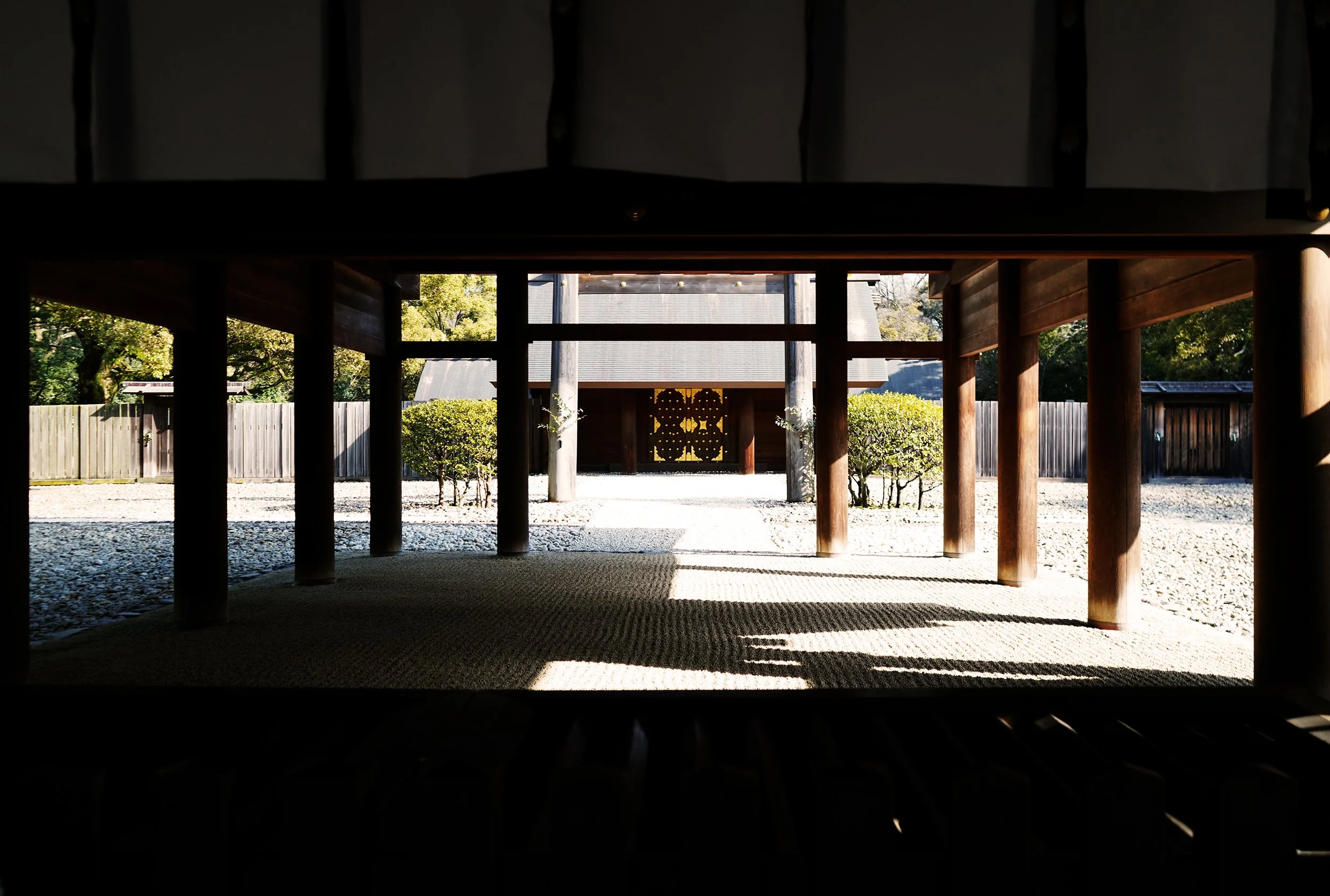
I grew up near shrines dedicated to Amaterasu. Light, nature, mirror. Her quiet symbolism stayed with me long after I left Japan. I keep her Ofuda in my office, not for luck, but for orientation. This lens is my way of finding the first step, remembering what drove the work then, and what still matters now.
In Nagoya, my hometown, Atsuta Jingu is one of many Shinto shrines connected to Amaterasu.Published:january 12, 2026 | updated:January 25, 2026